The onchain generative infrastructure stack
Onchain generative infrastructure is the technical backbone that allows artificial intelligence to operate directly on decentralized networks. It moves beyond the hype of tokenized assets to address the actual bottlenecks of AI: massive compute requirements, verifiable data sourcing, and transparent execution. This stack enables models to train, verify, and execute tasks in a trust-minimized environment.
Compute and Data Layers
The foundation of this stack relies on decentralized compute networks. These protocols distribute GPU resources across a global network, allowing AI workloads to run without relying on centralized cloud providers. This decentralization ensures that computational power is available, auditable, and resistant to single points of failure. Alongside compute, tokenized data markets provide models with access to verifiable, high-quality datasets. This transparency is critical for training models that need to operate in regulated or high-stakes financial environments where data provenance matters.
Execution and Settlement
The execution layer handles the actual inference and generation tasks, while the settlement layer ensures that the results are recorded immutably on the blockchain. This combination creates a system where AI outputs are not just generated but also cryptographically verified. For market participants, this infrastructure reduces counterparty risk and provides a clear audit trail for algorithmic decisions. As the digital economy evolves, this stack becomes the standard for deploying AI agents that interact with real-world assets and financial instruments.
Decentralized compute for AI workloads
Centralized cloud providers dominate the current AI landscape, but their pricing models and resource bottlenecks create significant friction for scalable onchain generative infrastructure. As AI agents become more capable, the demand for GPU cycles outpaces the capacity of traditional data centers, driving costs up and limiting accessibility. Decentralized networks are emerging as the necessary counterweight, offering a distributed alternative that democratizes access to high-performance computing.
These networks aggregate idle GPU power from individual providers and data centers, creating a liquid market for compute. This approach not only reduces costs by eliminating intermediary markups but also enhances resilience by distributing workloads across a global mesh of nodes. For onchain generative infrastructure, this means that training and inference tasks can be executed more efficiently, without relying on a single vendor’s supply chain.
The growth of onchain AI is moving faster than the infrastructure supporting it, according to industry observers. This acceleration highlights the urgency of building robust decentralized compute layers. By leveraging tokenized incentives, these networks ensure that hardware providers are fairly compensated while users get transparent, auditable access to the processing power they need to train models and run inference at scale.
Comparing Decentralized Compute Providers
| Network | Primary GPU Focus | Pricing Model | Consensus Mechanism |
|---|---|---|---|
| Render | NVIDIA GPUs | Token-based | Proof of Work |
| Akash | NVIDIA/AMD GPUs | Spot market | Proof of Stake |
| Io.net | NVIDIA GPUs | Token-based | Proof of Work |
These platforms differ in their hardware availability and economic models, but all share the goal of providing scalable, decentralized compute for AI workloads. As onchain generative infrastructure matures, the choice of compute provider will become a critical component of the stack, directly impacting performance, cost, and reliability.
Verifiable data markets and sources
The biggest bottleneck for onchain generative infrastructure isn't compute; it's data quality. AI models trained on unverified inputs inherit the biases and errors of their sources, creating a "garbage in, garbage out" loop that is fatal in high-stakes finance. Onchain data markets solve this by tokenizing data streams, ensuring that every piece of information used for training comes from a verifiable, auditable source.
Instead of scraping the open web, these systems pull directly from standardized onchain execution layers. As noted in infrastructure guides, this transforms raw blockchain data into interpretable objects that models can trust. When data is tokenized, its provenance is locked on the ledger, allowing AI agents to verify exactly where a price feed or transaction record originated before using it.
This shift from opaque datasets to transparent, onchain sources is critical for financial AI. It prevents model poisoning and ensures that the intelligence driving trading algorithms or risk assessments is built on a foundation of truth.

Autonomous agents and transaction execution
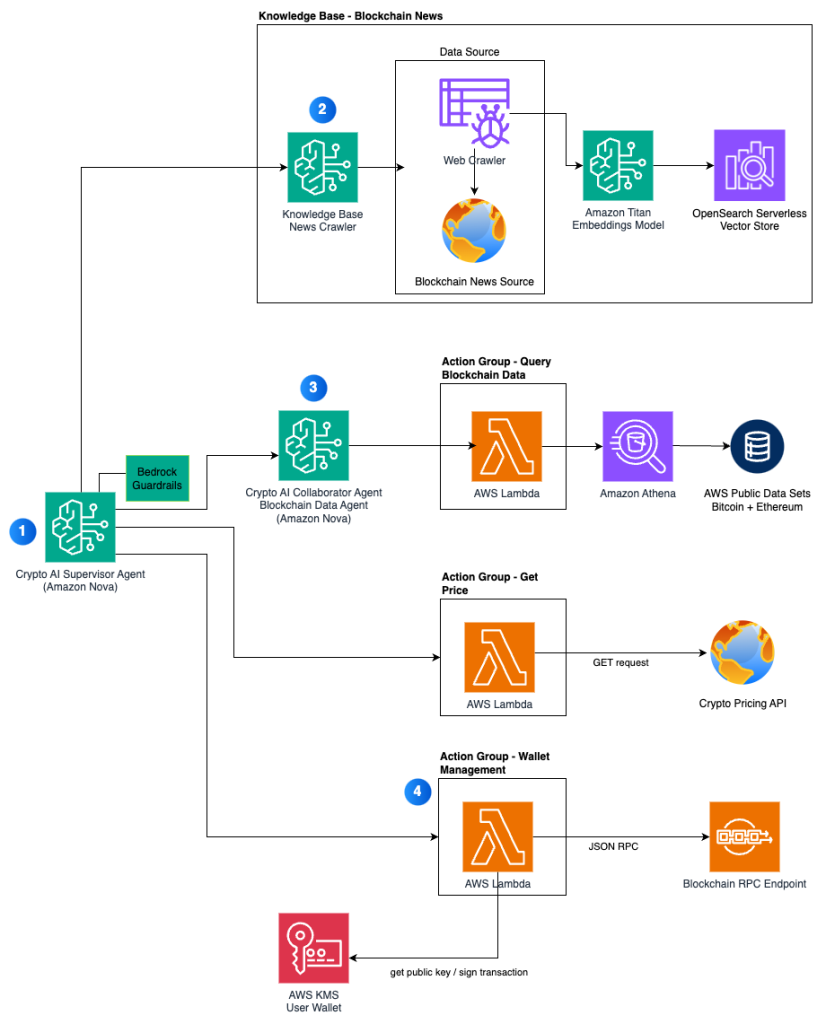
Onchain generative infrastructure is shifting from static smart contracts to dynamic, AI-driven workflows. At the core of this shift are autonomous agents—software programs that operate as independent actors with their own crypto wallets. These agents don't just wait for human input; they monitor the blockchain, interpret market signals, and execute transactions without manual intervention. As noted by Chainlink, this autonomy allows AI to act directly on-chain, bridging the gap between off-chain intelligence and on-chain execution.
The reliability of these agents depends on accurate data. Oracles feed real-world information into smart contracts, enabling agents to react to external events like price movements or weather data. Without this trusted data layer, autonomous decisions would be based on stale or manipulated inputs, leading to significant financial risk. The result is a system where AI agents can trade, lend, or manage assets in real-time, guided by algorithms rather than human reaction times.
This capability introduces a new level of efficiency to onchain generative infrastructure. Agents can operate 24/7, executing complex strategies across multiple protocols simultaneously. However, this autonomy also requires rigorous oversight. Blockchains provide the immutable ledger necessary to audit these actions, ensuring that agents follow their programmed rules. As Placeholder VC argues, this transparency is essential for scaling AI safely, allowing users to distinguish between legitimate machine actions and potential errors or exploits.
Strategic Allocation and Risk Modeling
Institutional capital has long been hesitant about digital assets, not because of a lack of interest, but due to opaque risk profiles. Traditional off-chain ledgers make it difficult to verify asset provenance and real-time exposure, forcing allocators to rely on third-party audits that are often weeks old. Onchain generative infrastructure changes this dynamic by providing a transparent, programmatic layer for risk modeling. Instead of guessing at exposure, institutions can now verify positions directly on the blockchain.
This shift allows for precise, real-time risk assessment. Onchain infrastructure does not generate yield; it optimizes existing yield by removing the friction and opacity that typically inflate risk premiums. When every transaction is recorded on an immutable, public ledger, the cost of due diligence drops significantly. This transparency enables more efficient capital allocation, as institutions can trust the data without needing to wait for centralized reports.
The result is a more sophisticated approach to managing digital assets. By leveraging onchain generative infrastructure, allocators can model risks with greater accuracy, leading to more confident deployment of capital. This precision is essential for high-stakes finance, where the margin for error is slim and the need for verifiable data is paramount.
Common questions about onchain AI
The intersection of blockchain and generative AI creates new infrastructure layers that require precise definition. Here are the answers to the most frequent questions about how these systems operate.
Understanding these definitions clarifies how onchain generative infrastructure differs from traditional web3 or offchain AI services. The distinction lies in where the computation and data permanence reside.
Helpful gear
Use these product recommendations as a starting point, then choose the size, material, and price point that fit how you actually use the gear.
- Good starting point
- Matches the article topic
As an Amazon Associate, we may earn from qualifying purchases.
No comments yet. Be the first to share your thoughts!