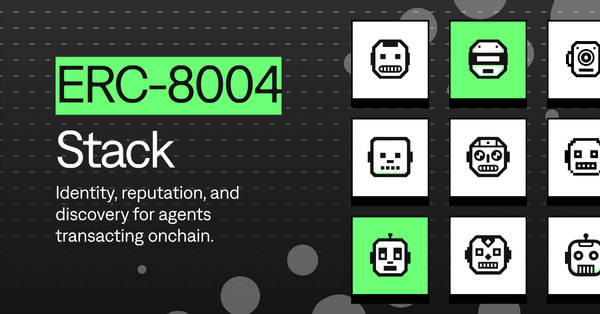
The onchain generative infrastructure stack
Onchain generative infrastructure is not a single product; it is a three-layer stack where data, compute, and execution converge. This architecture differs fundamentally from offchain AI because the output is verifiable, immutable, and executable by code. Instead of generating text or images that sit in a database, these systems produce tokens, contracts, and assets that settle on a blockchain.
Data: The Verifiable Foundation
Generative models require massive datasets, but onchain infrastructure prioritizes provenance. Data sources are often anchored on-chain, allowing models to train on assets with clear ownership and history. This creates a feedback loop where the quality of the training data is as important as the model itself. Without this layer, the "generative" aspect lacks the trustless verification that defines the onchain economy.
Compute: Decentralized Processing
Training and inference for generative models demand significant computational power. Onchain infrastructure distributes this load across decentralized networks of nodes. This approach reduces reliance on centralized cloud providers and lowers costs through competition. The compute layer ensures that the heavy lifting required to generate complex outputs happens transparently, with resource allocation recorded on the ledger.
Execution: Settlement and Verification
The final layer is execution. Once data is processed and compute is complete, the result is executed as a smart contract. This step locks the output into the blockchain, making it permanent and immutable. This convergence of data, compute, and execution creates a distinct value proposition: AI that can act, not just predict. The result is a system where every step of the generative process is auditable.
To understand the market context of this settlement layer, consider the underlying asset often used for gas and security: Ethereum.
AI-Ready Onchain Data Layers
Raw blockchain data is a liability for autonomous agents. Every node records the same transaction, but the ledger itself is a disjointed stream of hashes, block numbers, and raw calldata. An agent parsing this directly faces a fragmentation problem: it cannot easily distinguish between a token transfer, a contract deployment, or a liquidity pool rebalance without executing complex, error-prone decoding logic in real time. This noise makes reliable automation nearly impossible at scale.
The solution is a normalized, temporal data layer. Instead of reading the ledger, agents read a structured dataset where events are reconciled and labeled. As Allium notes, this process involves making data "temporally consistent" so that an agent can query "what happened to User A's balance between Tuesday and Wednesday" rather than "scan 40,000 blocks for log events." This abstraction transforms the blockchain from a database to be cracked into a feed to be consumed.
This shift enables agents to operate with financial-grade precision. When data is pre-processed, the agent’s role shifts from data engineering to decision-making. It can execute trades, monitor risk, or rebalance portfolios based on clean signals rather than noisy raw inputs. The bottleneck moves from data retrieval to strategy execution, allowing autonomous systems to interact with DeFi protocols with the same reliability as traditional API integrations.
Agentic execution and smart contracts
The shift toward agentic execution marks a structural change in how capital moves onchain. AI agents no longer just analyze data; they interact directly with smart contracts to execute trades, manage assets, and navigate DeFi protocols autonomously. This transition relies on infrastructure layers that prioritize transparency and programmability, moving beyond traditional offchain models where execution logic is often opaque and settlement is delayed.
The core advantage lies in the alignment of intent and execution. When an AI agent operates onchain, its actions are bound by the code of the smart contract, ensuring that every step of the trade or asset management process is verifiable. This contrasts sharply with offchain AI systems, where the "black box" nature of the model can obscure how decisions are made until settlement occurs. Onchain agentic execution eliminates this latency and opacity, allowing for real-time verification of compliance and strategy.
| Feature | Traditional Offchain AI Execution | Onchain Agentic Execution |
|---|---|---|
| Transparency | Low (Black box logic) | High (Public ledger verification) |
| Settlement | Delayed (Batched or manual) | Instant (Atomic transaction) |
| Programmability | Limited (API-dependent) | High (Direct smart contract interaction) |
| Auditability | Post-hoc (Hard to trace) | Real-time (Every action recorded) |
This infrastructure evolution enables more efficient capital markets. Smart contracts make these processes scalable and reliable, reducing the need for intermediaries and minimizing counterparty risk. As the industry moves toward this model, the focus shifts from speculative AI hype to practical implementation—building robust agents that can handle high-stakes financial operations with the same rigor as traditional institutional systems.
| Feature | Offchain AI | Onchain Agentic |
|---|---|---|
| Transparency | Low | High |
| Settlement | Delayed | Instant |
| Programmability | Limited | High |
| Auditability | Post-hoc | Real-time |
Onchain generative tools for builders
The bridge between centralized model weights and decentralized execution is where the real utility lies. Builders are no longer just deploying smart contracts; they are integrating generative AI agents that operate with verifiable state. This section outlines the specific infrastructure layers and platforms enabling this convergence.
Decentralized AI Agent Frameworks
Platforms like Elna.ai are pioneering the "fully on-chain" model, allowing developers to deploy customized AI agents that interact directly with blockchain protocols. Unlike traditional APIs that rely on centralized servers, these agents execute logic on-chain, ensuring transparency and reducing counterparty risk. This approach transforms AI from a black-box service into a transparent, autonomous entity that can manage assets or execute trades based on predefined, auditable rules.
Onchain Data Oracles for LLMs
Generative models require high-quality, real-time data to function effectively in financial contexts. Infrastructure providers are building specialized oracles that feed verified on-chain data directly into LLM inference engines. This integration allows models to generate insights based on immutable transaction history rather than potentially manipulated web data. The result is a more reliable feedback loop for predictive analytics and automated decision-making systems.
Compute Abstraction Layers
Running large language models on-chain is computationally expensive and technically constrained. Abstraction layers are emerging to handle the heavy lifting, allowing developers to invoke complex generative functions without managing the underlying distributed compute resources. These layers optimize cost and latency, making it feasible to integrate AI capabilities into dApps without requiring developers to become experts in distributed systems architecture.


As an Amazon Associate, we may earn from qualifying purchases.
Strategic Implications for 2026
The convergence of generative AI and blockchain is shifting from experimental pilots to foundational infrastructure. In 2026, the primary value lies not in the models themselves, but in the onchain systems that verify, own, and transact with the outputs. This distinction separates speculative hype from durable financial utility.
Stakeholders must prioritize infrastructure layers that handle identity and verification. As AI agents become more autonomous, the need for internet-native identity systems grows critical. Circle’s recent analysis highlights how AI and onchain financial infrastructure are accelerating this demand, creating a clear path for identity-focused protocols.
For investors, the focus should be on the plumbing: data availability, zero-knowledge proofs, and agent-to-agent payment rails. These components form the backbone of the onchain economy, enabling the secure creation and exchange of digital assets at scale. The winners will be those building the trust layer for AI-driven transactions.
No comments yet. Be the first to share your thoughts!